

Reticular Materials
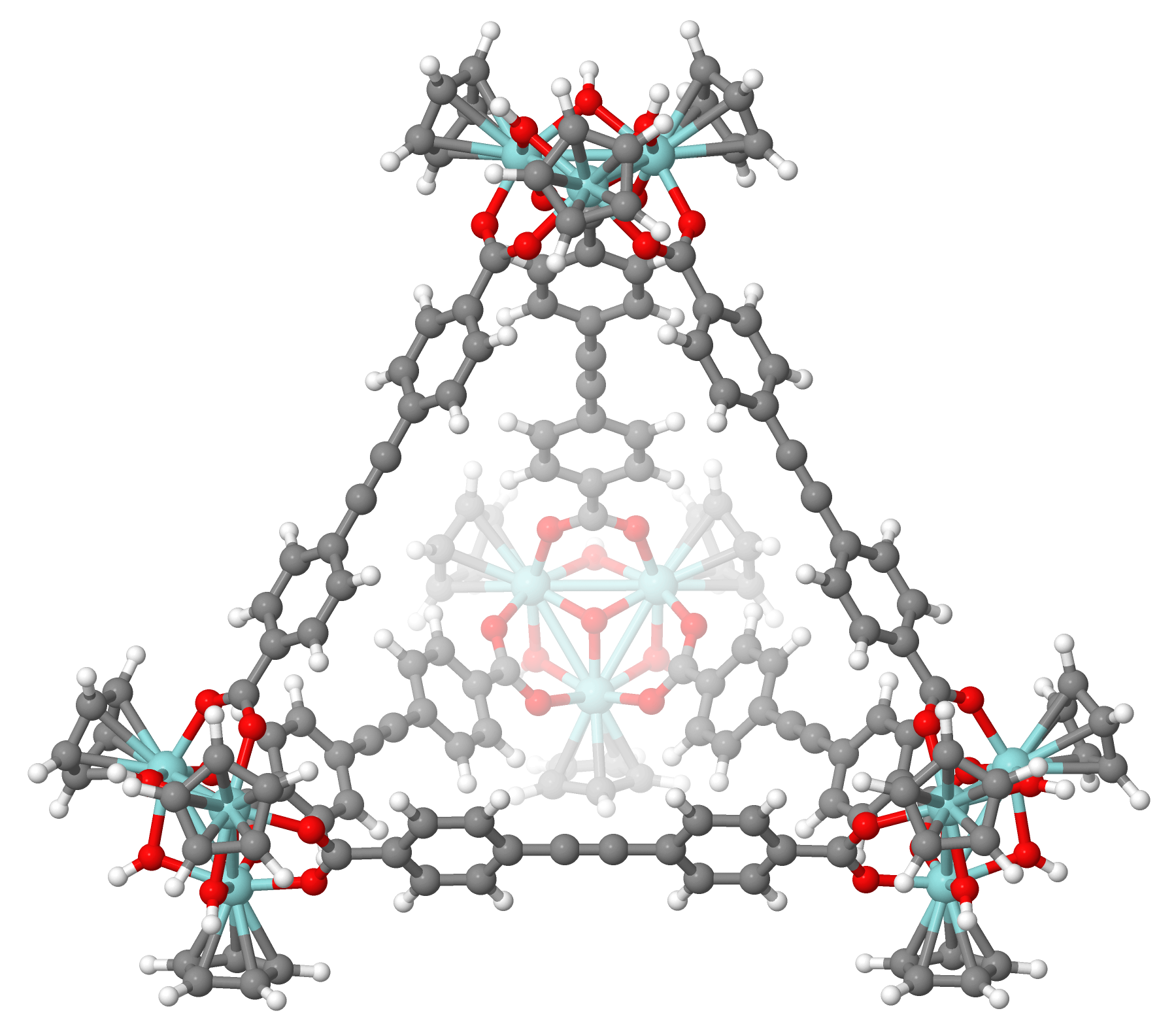
Reticular materials are built by linking modular molecular components into predetermined topologies, giving families such as metal-organic frameworks (MOFs), covalent-organic frameworks (COFs), and metal-organic polyhedra (MOPs). The number of ways in which components can be combined, the topologies they can form, and the conditions needed to synthesise them create a vast design space. The CoMo group's work in this area uses MOPs as a tractable testbed for digital reticular chemistry: representing, designing, modelling, screening, synthesising, and experimentally verifying modular materials within one connected, machine-readable discovery environment.
The approach separates the chemical identity of a building unit (a chemical building unit, or CBU) from the abstract geometric role it plays (a generic building unit, or GBU), and captures how GBUs combine into a given cage topology as an assembly model (AM). These concepts, together with curated structures, components, and properties, are represented in the OntoMOPs ontology as part of The World Avatar knowledge graph, alongside related ontologies for species, synthesis procedures, and computational results. Starting from a curated set of experimentally known MOPs and CBUs, rule-based agents propose new constructible combinations; an automated geometry assembler then converts these into atomistic structures, which are refined and screened using quantum-chemical methods and machine-learning interatomic potentials. Fragment-based design and evolutionary optimisation extend this further, recombining known and more general molecular fragments to reach design spaces of many millions of candidate building units and to target specific properties such as gas capture or host-guest binding.
The programme's most recent work closes the loop from digital design to physical synthesis: an analogy-based predictor uses linked structural and procedural precedent in the knowledge graph to propose reactants, solvents, and heating conditions for new MOPs, directly from a machine-readable representation. This was used to predict and manually synthesise a previously unreported zirconium-based MOP, with the resulting structure supported by infrared spectroscopy, mass spectrometry, and X-ray diffraction evidence. This constitutes a proof-of-concept, end-to-end discovery cycle from semantic representation through to an experimentally verified material.
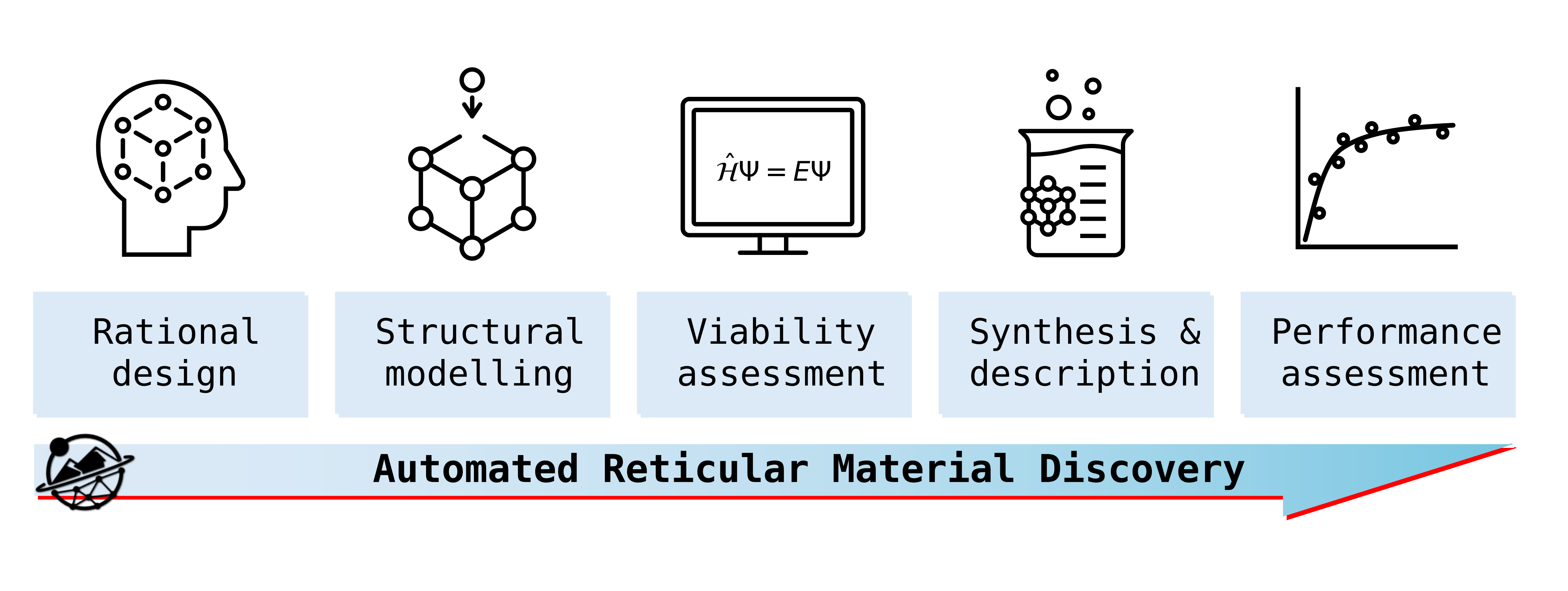
Above illustration is an overview of the automated workflow for the discovery of reticular materials. Click on any of the stages to explore our work in those areas.
Recent Associated Preprints
349: LinkerGen: Guided Autoregressive Generation of Organic Linkers for Reticular Chemistry
Patrick Butler, Marcello Costamagna, Felix C. Mocanu, Simon D. Rihm, Feroz Farazi, Sebastian Mosbach, Jethro Akroyd, and Markus Kraft, Technical Report 349, c4e-Preprint Series, Cambridge, 2026.
347: Prediction and synthesis of novel metal-organic polyhedra in The World Avatar
Simon D. Rihm, Patrick Butler, Kumaran Elumalai, Ari F. Fischer, Pei Chong Lim, Rong Xu, Tej S. Choksi, Aleksandar Kondinski, and Markus Kraft, Technical Report 347, c4e-Preprint Series, Cambridge, 2026.
345: Leveraging General Molecular Fragments to Expand the Design Space of Metal-Organic Polyhedra
Patrick Butler, Simon D. Rihm, Sebastian Mosbach, Jethro Akroyd, and Markus Kraft, Technical Report 345, c4e-Preprint Series, Cambridge, 2026.
343: Ontology-to-tools compilation for executable semantic control of large language models
Xiaochi Zhou, Patrick Butler, Changxuan Yang, Simon D. Rihm, Thitikarn Angkanaporn, Jethro Akroyd, Sebastian Mosbach, and Markus Kraft, Technical Report 343, c4e-Preprint Series, Cambridge, 2026.
Recent Associated Publications
Leveraging General Molecular Fragments to Expand the Design Space of Metal-Organic Polyhedra
Patrick Butler, Simon D. Rihm, Sebastian Mosbach, Jethro Akroyd, and Markus Kraft, Physical Chemistry Chemical Physics 28, 17787-17791, (2026).
Computational Modelling Workflows for Metal-Organic Polyhedra in The World Avatar
Patrick Butler, Simon D. Rihm, Sebastian Mosbach, Jethro Akroyd, and Markus Kraft, Physical Chemistry Chemical Physics 28, 14828-14838, (2026).
Patrick Butler, Simon D. Rihm, Sebastian Mosbach, Jethro Akroyd, and Markus Kraft, Journal of Chemical Information and Modeling 66(7), 3933-3943, (2026).
Product design, synthesis, and lab automation with The World Avatar
Simon D. Rihm, Aleksandar Kondinski, and Markus Kraft, Current Opinion in Chemical Engineering 51, 101203, (2026).
Funding
This research was partly funded by the National Research Foundation (NRF), Prime Minister's Office, Singapore under its Campus for Research Excellence and Technological Enterprise (CREATE) programme.