


Technical Report 349, c4e-Preprint Series, Cambridge
LinkerGen: Guided Autoregressive Generation of Organic Linkers for Reticular Chemistry
Reference: Technical Report 349, c4e-Preprint Series, Cambridge, 2026
Associated Themes:

- Generative model for reticular organic chemical building units (CBUs) widen the chemical linker space available for the design of metal-organic polyhedra
- Conditioning enriches generated populations in linkers with desired properties
- Text conditioning allows complex chemical requirements to be effectively expressed in natural language
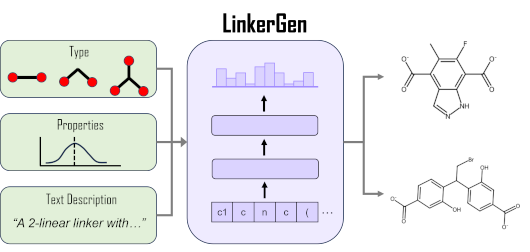 Organic linker design for reticular materials requires balancing molecular diversity with structural and chemical constraints. Here, we introduce LinkerGen, a compact SMILES-based autoregressive model guided by chemical building unit (CBU) types, numerical property targets, or text descriptions. We train and evaluate two model sizes on approximately 22 million fragment-enumerated carboxylate linkers spanning 2-linear, 2-bent, and 3-planar CBU types. Model size and sampling temperature adjust the balance between validity and novelty, while conditioning increases the yield of distinct, valid, novel candidates satisfying selected requests compared with unconditioned generation followed by filtering. Text conditioning combines molecular requirements in a single natural-language request, although its effectiveness depends on training coverage and prompt formulation. A prospective application connects literature-informed linker generation to metal–organic polyhedron (MOP) assembly and calculated binding energies for 5-fluorouracil, illustrating how chemical design hypotheses can be explored through computational screening. LinkerGen provides a steerable source of candidate building units and a basis for adaptation to other linker families and design objectives through suitable training data and conditioning information.
PDF (8.4 MB)