


Technical Report 347, c4e-Preprint Series, Cambridge
Prediction and synthesis of novel metal-organic polyhedra in The World Avatar
Reference: Technical Report 347, c4e-Preprint Series, Cambridge, 2026
Associated Themes:


- A semantic workflow within The World Avatar predicts synthesis of novel MOPs.
- First complete MOP discovery cycle based in a single persistent knowledge base.
- Synthesis conditions are inferred by analogy to known MOP procedures.
- Computational screening links molecular design to crystal verification.
- A novel Zr-EDB-MOP experimentally validates the end-to-end workflow.
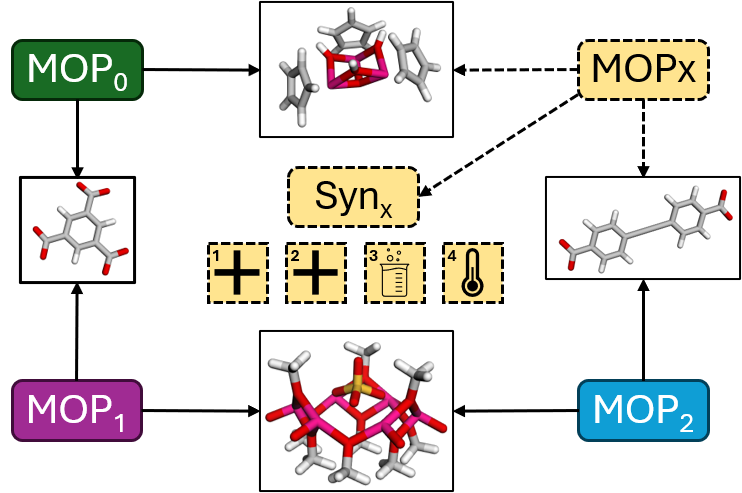 Metal-organic polyhedra (MOPs) offer a modular route to porous molecular materials, but their discovery is limited by the difficulty of translating digital designs into experimentally accessible compounds. Here, we demonstrate an integrated workflow for predicting and synthesising novel MOPs in The World Avatar. To our knowledge, this is the first reticular material discovery workflow executed and persisted entirely in a shared machine-readable knowledge representation, without human-specified initial reaction conditions. This domain's small literature corpus hinders data-driven synthesis prediction, yet its high symmetry provides exploitable structural analogies. We therefore encode auditable chemical reasoning as explicit rules rather than learning it statistically. MOP candidates are linked to synthesis knowledge, so procedures for new targets are inferred by analogy to known materials and rendered as human-readable instructions and machine-executable protocols. Candidates are assessed through hierarchical geometry optimisation, electronic-structure evaluation, crystal structure prediction, and simulated powder X-ray diffraction. We evaluate the workflow retrospectively against reported zirconium MOP syntheses and prospectively by synthesising a previously unreported Zr-EDB-MOP. Infrared spectroscopy, high-resolution mass spectrometry, and powder X-ray diffraction support formation of the targeted cage in agreement with the predicted model. This establishes a proof of concept for knowledge-integrated discovery in sparse, highly structured materials domains.
This preprint is also available in the ChemRxiv at doi:10.26434/chemrxiv.15007397/v1.
PDF (7.8 MB)