


Technical Report 345, c4e-Preprint Series, Cambridge
Leveraging General Molecular Fragments to Expand the Design Space of Metal-Organic Polyhedra
Reference: Technical Report 345, c4e-Preprint Series, Cambridge, 2026
Associated Themes:

- Workflow to extract molecular fragments suitable for organic building units
- Generate a library of 12,387 fragments from ChEMBL36
- Enumerate a dataset of 44.8 M organic building units over 11 templates
- Using a genetic algorithm, optimise MOPs for a drug delivery application
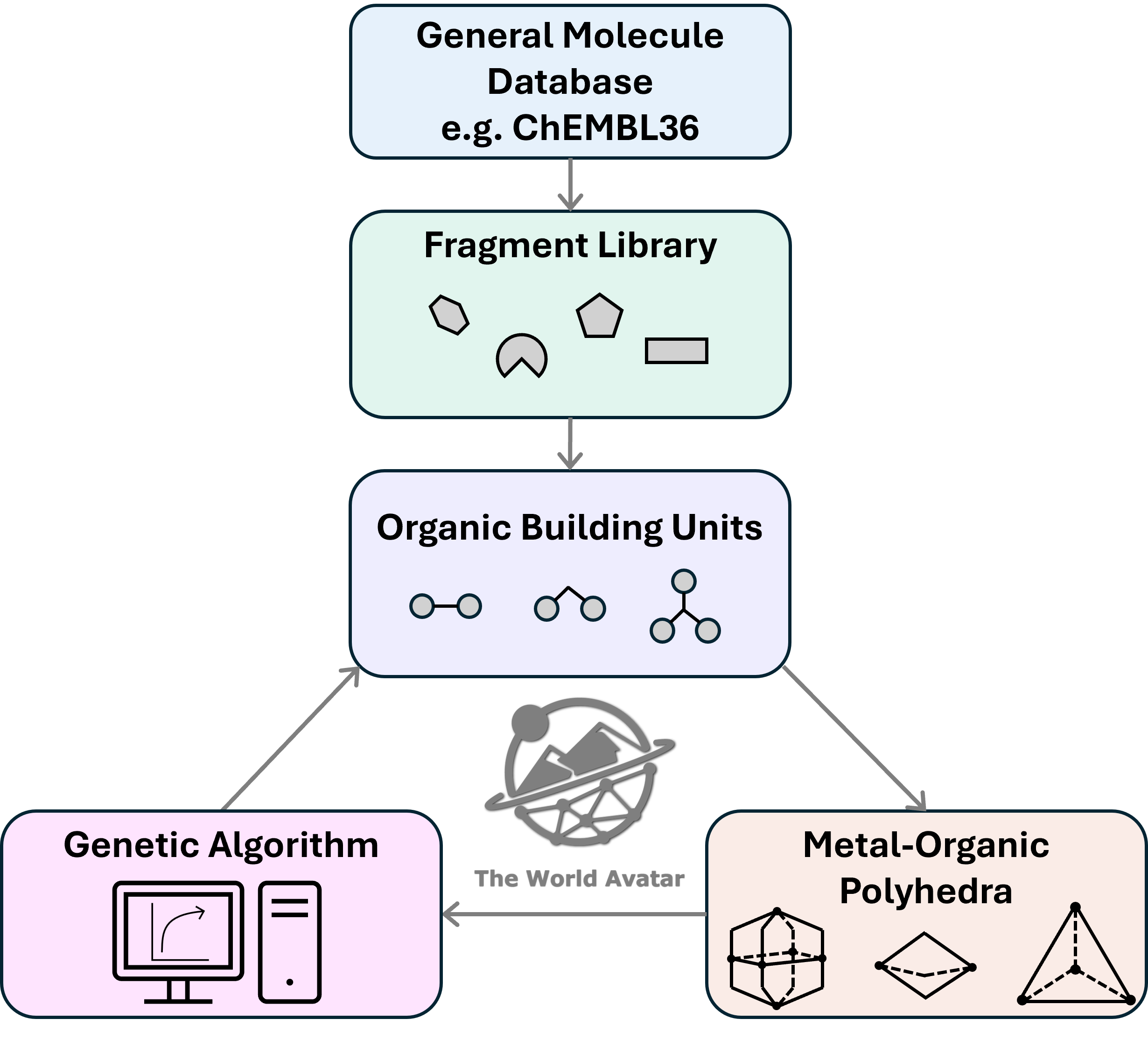 The discovery of functional reticular materials is dependent on optimising the organic building unit to achieve precise chemical and structural properties. However, experimentally characterised chemical building units (CBUs) are only a small fraction of the possible design space, and as such, computer-aided design based on datasets of known reticular materials have fundamental limitations in chemical diversity. Here, we present a general workflow for extracting, analysing, and recombining molecular fragments from large, chemically diverse datasets to systematically expand the accessible organic CBU design space. Using the ChEMBL36 database as a case study, we generate a library of 12,387 unique fragments through filtering, fragmentation, and ontology-driven classification. These fragments are recombined to enumerate a dataset of 44.8 million CBUs. To demonstrate integrating the workflow into designing functional reticular materials, we combine the library with a genetic algorithm and optimise for metal-organic polyhedra (MOPs) estimated as stable, non-toxic drug carriers. The concepts and relationships between the molecular fragments, CBUs, templates, and MOPs are captured and connected through a knowledge graph and ontology integrated in The World Avatar.
This preprint is also available in the ChemRxiv at doi:10.26434/chemrxiv.15002417/v1.
Material from this preprint has been published in Physical Chemistry Chemical Physics.
PDF (15.1 MB)