


Assessment of individualised dynamic environmental exposures within The World Avatar
- Dynamic individualised environmental exposures calculated within digital twins powered by The World Avatar.
- Ontologies create interoperability across urban environmental features.
- Semantically distinguishes historic features of the environment and time-specific availability.
- Enables scalable and transferable mobility-aware assessment.
- Demonstrated using location tracking data both in the UK and Singapore.
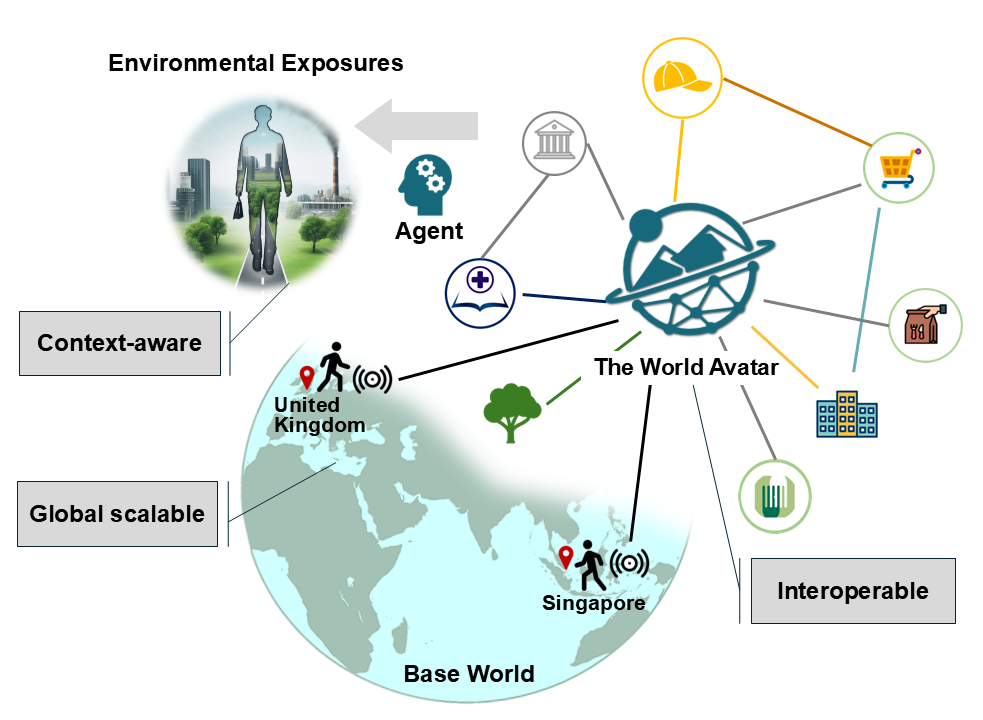 The environment in which people spend their lives influences their health behaviours and health outcomes. Traditional studies often use fixed descriptions and ad hoc analyses to characterise environmental exposures at static locations, relating a single environmental factor to one health aspect, even though both the environment and the exposures of people who move through it are dynamic. We introduce a digital twinning approach that semantically integrates ontological concepts and data across environmental features into machine-readable knowledge, enabling scalable and context-aware assessment of individual exposures. This work is built on The World Avatar project, which aims to create an all-encompassing digital twin based on a dynamic knowledge graph. The proposed approach deploys a computational agent to calculate exposures based on semantic representations of environmental features in time and space. The time-specific part of the exposure calculation considers both the historical context (i.e. whether features of the environment had been built) and current context (i.e., whether something was open or accessible) of the exposure. The scalability of the approach is illustrated through the construction of interoperable digital twins and the analysis of smartphone data describing movements in both the UK and Singapore. The resulting exposures capture historic year-specific changes in greenspace and time-specific accessibility based on opening hours of the food retail environment. This approach could facilitate large-scale digital studies, yielding critical insights that help create healthy cities.
- This paper draws from preprint 337: Assessment of individualised dynamic environmental exposures within The World Avatar
- Access the article at the publisher: DOI: 10.1016/j.compenvurbsys.2026.102476
Associated Themes:
