


Technical Report 350, c4e-Preprint Series, Cambridge
What should AI agents know? Explicit knowledge for trustworthy, sustainable materials research
Reference: Technical Report 350, c4e-Preprint Series, Cambridge, 2026
Associated Themes:


- Scientific AI needs a shared, traceable record of what is known, how it was derived and which actions are justified.
- Ontology-grounded knowledge graphs share scientific meaning across disciplines, systems and scales, with automated provenance for registered computations.
- Ontology-derived tool contracts constrain LLM actions, but formal validity does not guarantee scientific correctness.
- A new porous cage material was designed, screened, synthesised and characterised within one connected knowledge graph.
- Faster AI discovery is not automatically sustainable: benefits must be tested from synthesis to full energy systems.
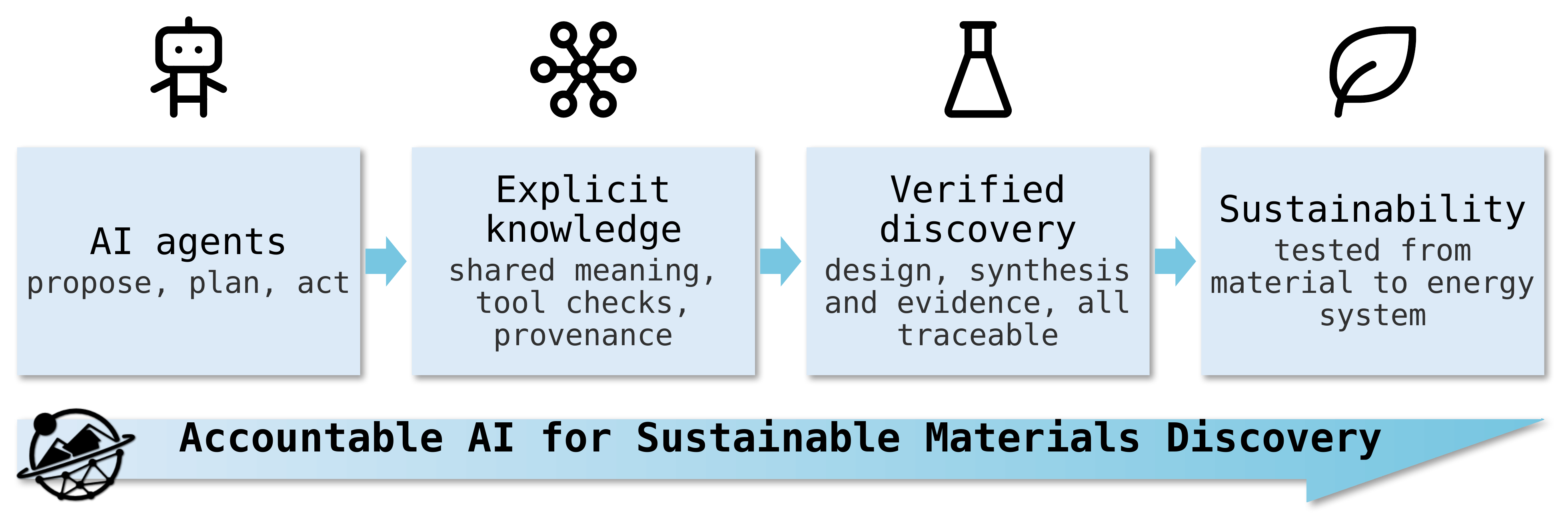 Artificial intelligence can propose materials, interpret measurements and increasingly coordinate experiments. Yet reliable scientific autonomy requires more than capable models: research systems must preserve what is known, where evidence came from and which actions are justified. We argue that machine-actionable scientific knowledge is essential for trustworthy autonomous research, and that ontology-grounded knowledge graphs are a particularly powerful way of achieving it when scientific meaning must be shared across disciplines, systems and scales. Using The World Avatar (TWA) as a case study, we examine how ontologies, dynamic knowledge graphs and software agents connect models, literature, experiments and laboratory assets, and how ontology-derived tools can constrain large language model (LLM) actions. A reported design-to-synthesis study of a new metal-organic polyhedron demonstrates the integration of previously separate tasks, but not yet an environmental benefit or fully autonomous discovery. A material-passport example further shows how shared semantics can support industrial circularity assessment. We distinguish structural validation from scientific verification, and circularity indicators from demonstrated environmental benefits. The priority is not to create a universal platform but to build evidence-preserving research infrastructure whose scientific and sustainability benefits can be tested.
This preprint is also available in the ChemRxiv at doi:10.26434/chemrxiv.15012070/v1.
PDF (1.4 MB)