


Technical Report 344, c4e-Preprint Series, Cambridge
Semantic agent-workflow for cross-city heat planning and sector coupling
Reference: Technical Report 344, c4e-Preprint Series, Cambridge, 2026
Associated Themes:

- Unified workflow for building heat-demand simulation is demonstrated in two cities.
- Quantify rooftop solar heating and evaluate storage effects on project economics.
- Semantic data architecture supports consistent cross-city analysis.
- Conduct regional coordination to share surplus power and increase hydrogen output.
- Support municipal planning in line with the German Federal Heat Planning Act.
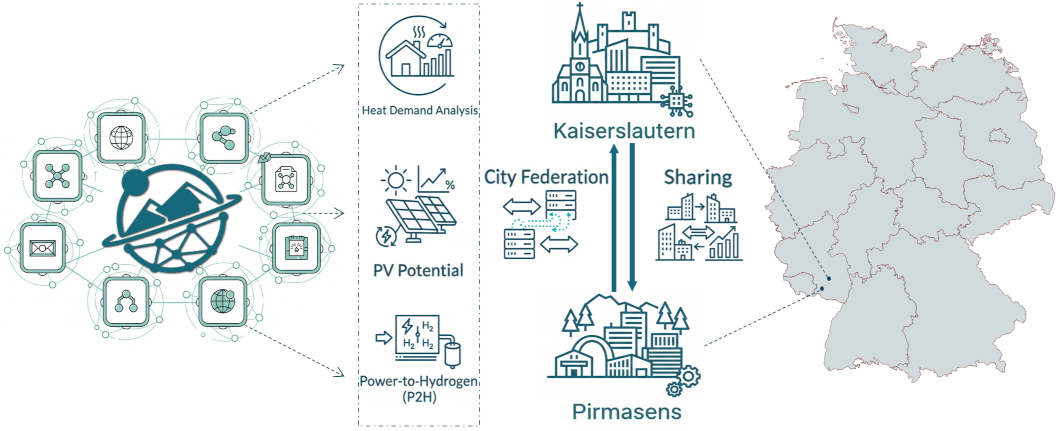 Heating is a major component of urban energy use. The German Federal Heat Planning Act requires municipalities to prepare transparent, spatially consistent heat plans. Current practices rely on disparate datasets and separate models, making it difficult to compare cities or coordinate action beyond municipal boundaries. To address this gap, this study demonstrates a unified, semantic and agent-based data architecture based on dynamic knowledge graphs that automates data retrieval, harmonises building information and supports reproducible simulations. The framework is applied to two neighbouring German cities to quantify heating demand, rooftop solar-heating potential and the techno-economic impact of adding thermal storage. Results show that 69% of buildings in Pirmasens and 56% in Kaiserslautern achieve a positive net present value for solar heating without storage, while coordinated operation increases usable surplus power and can supply up to 93 tonnes of green hydrogen per year, avoiding nearly 1 kilotonne of CO2. By linking municipal knowledge graphs through a shared semantic layer, the framework enables interoperable and consistent cross-city assessment of heating demand, solar potential, and surplus-electricity coordination. The work demonstrates how semantic infrastructure can operationalise national heat-planning mandates and provide a transferable digital backbone for integrated low-carbon urban and industrial development through sector coupling.
PDF (12.1 MB)