



Technical Report 342, c4e-Preprint Series, Cambridge
Cold homes, unsafe communities, and limited healthy opportunities: Evidence on neighbourhood exposures and non-communicable diseases via The World Avatar
Reference: Technical Report 342, c4e-Preprint Series, Cambridge, 2025
Associated Themes:

- Semantic integration turns open data into actionable population-health evidence.
- Leisure centres within 4 min and fast food beyond 6 min signal healthier places.
- Fuel poverty links to COPD; warmer homes could cut the burden by over 13%.
- Rising crime and fuel poverty track rising mental illness; mid-level greenness offers protection.
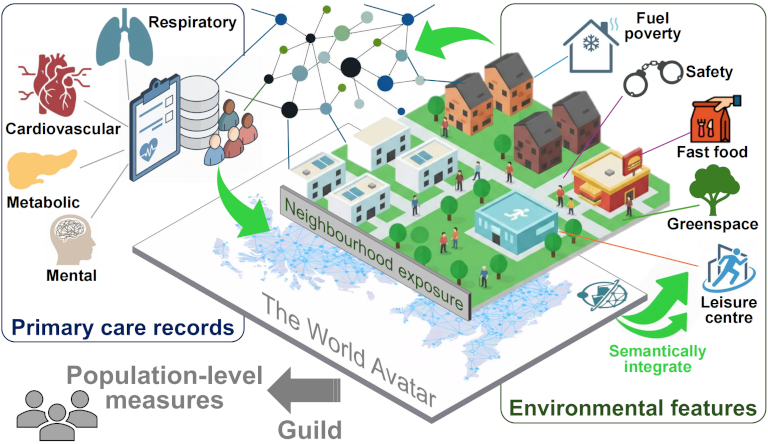 Urban environments shape non-communicable disease (NCD) patterns, yet the transformation of public data into granular, policy-actionable evidence remains challenging as cross-sector data silos and heterogeneous standards impede at-scale harmonisation and holistic analysis.
We built a UK-wide, small-area environmental health evidence base by semantically integrating national datasets including housing, neighbourhood amenities, community safety, and accessibility within The World Avatar (TWA), an interoperable knowledge architecture enabling machine-readable, consistent profiling of adjusted associations between determinants, covariates, and primary-care disease prevalence. Results show that fuel poverty emerged as a leading correlate of respiratory morbidity: scenarios consistent with improved home heating efficiency suggest that reducing fuel poverty could be associated with averting over 13% of the population burden of chronic obstructive pulmonary disease. Spatial profiling identified critical proximity thresholds: leisure-centre access was protective within an approximately 4-minute drive, while health risks linked to fast-food outlets declined beyond roughly 6 minutes. Mental-health burden showed strong, monotonic associations with antisocial behaviour, domestic abuse, and drug-related crime. Green space supported metabolic health but exhibited a U-shaped association with severe mental illness, with the lowest prevalence at intermediate vegetation density (NDVI 0.5-0.6). These findings show how semantic integration can generate actionable, scalable environmental intelligence for digital health systems and place-based prevention.
Urban environments shape non-communicable disease (NCD) patterns, yet the transformation of public data into granular, policy-actionable evidence remains challenging as cross-sector data silos and heterogeneous standards impede at-scale harmonisation and holistic analysis.
We built a UK-wide, small-area environmental health evidence base by semantically integrating national datasets including housing, neighbourhood amenities, community safety, and accessibility within The World Avatar (TWA), an interoperable knowledge architecture enabling machine-readable, consistent profiling of adjusted associations between determinants, covariates, and primary-care disease prevalence. Results show that fuel poverty emerged as a leading correlate of respiratory morbidity: scenarios consistent with improved home heating efficiency suggest that reducing fuel poverty could be associated with averting over 13% of the population burden of chronic obstructive pulmonary disease. Spatial profiling identified critical proximity thresholds: leisure-centre access was protective within an approximately 4-minute drive, while health risks linked to fast-food outlets declined beyond roughly 6 minutes. Mental-health burden showed strong, monotonic associations with antisocial behaviour, domestic abuse, and drug-related crime. Green space supported metabolic health but exhibited a U-shaped association with severe mental illness, with the lowest prevalence at intermediate vegetation density (NDVI 0.5-0.6). These findings show how semantic integration can generate actionable, scalable environmental intelligence for digital health systems and place-based prevention.
PDF (7.4 MB)