



A Material Passport Ontology for a circular economy
- A material passport ontology to represent manufactured products and materials.
- A semantic infrastructure to enable interoperability of material passports.
- A material passport knowledge graph to assess metrics of circular economy.
- Rules for validating data structures and acceptable value ranges.
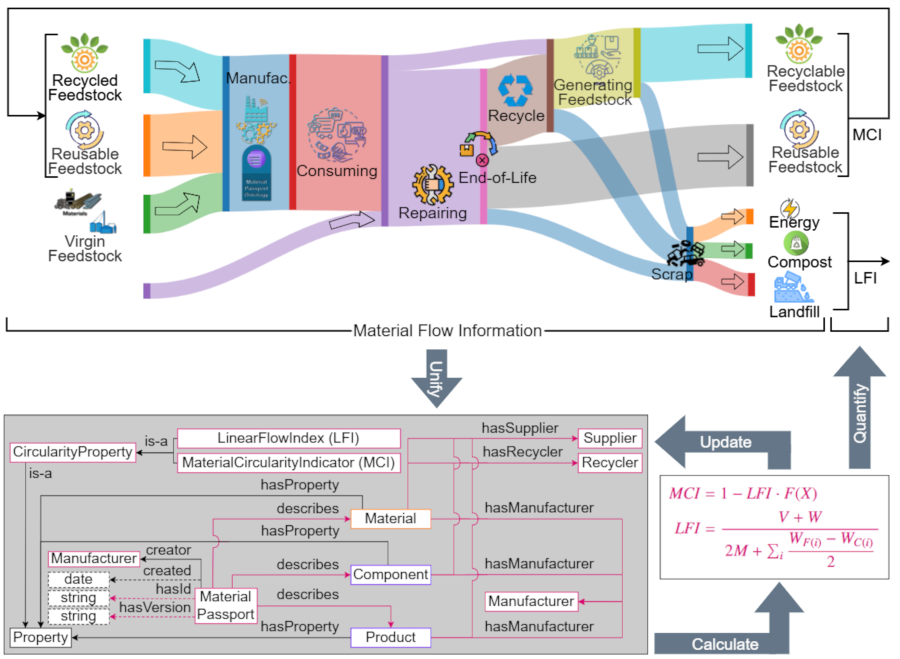 The purpose of this paper is to introduce a Material Passport Ontology (MPO), which is designed to enable the interoperability of material passport data across stakeholders, including manufacturers, suppliers, collectors, and recyclers. The MPO provides a novel unifying ontological infrastructure for representing the properties of products and recycling processes. These properties are essential for estimating the potential recycled yield and enabling the stakeholders to make informed decisions about the feasibility of recycling. The ontology was co-created with industrial stakeholders, following a pragmatic ontology development method. The MPO is organised into facets describing the physical properties, composition and circularity, biological and other properties of products, components and materials. A set of constraints was developed to address the non-conformant syntactic or value range inconsistencies identified by the industrial stakeholders. These inconsistencies occurred in properties such as international product identification numbers and mass-related properties represented in a material passport knowledge graph. The information provided by the knowledge graph enables the assessment of the circularity of products, components and materials. The MPO was validated using reasoning tools and in collaboration with domain experts from industrial partners representing two use cases: the manufacture of components for motor vehicles and blades for wind turbines. These use cases demonstrate its effectiveness and applicability in identifying recyclable materials, maximising resource reuse, and enhancing sustainability practices, thereby facilitating the transition to a circular economy.
- This paper draws from preprint 328: A Material Passport Ontology for a Circular Economy
- Access the article at the publisher: DOI: 10.1016/j.compind.2026.104465
Associated Themes:
