


The sun always shines somewhere – the energetic feasibility of a global grid with 100% renewable electricity
- Optimising a global renewable electricity system to minimise surplus generation
- Spatial allocation of wind and solar PV deployment and inter-regional power flow simulation
- Time-series analysis of global power flows, regional generation, and demand profiles
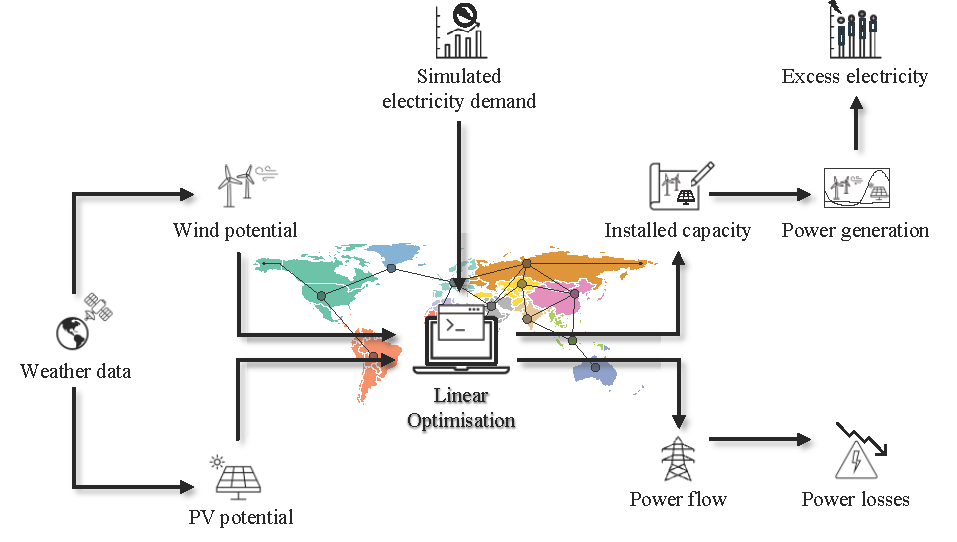 The defossilisation of the global electricity system is critical for mitigating climate change. Wind and solar PV play critical roles in this shift; however, their intermittency presents a significant challenge. Intercontinental electricity transmission offers a potential solution to mitigate this intermittency. This study investigates the energetic feasibility of a hypothetical global electricity grid relying solely on wind and solar PV energy. An optimisation problem was solved to determine the deployment of wind and solar PV capacities that minimise excess electricity generation. The simulations use a much higher spatial resolution of renewable potentials than in previous studies of global grids. They suggest that a global grid could reduce excess electricity generation by up to 92% compared to an equivalent no transmission scenario and increase the correlation coefficient between the time-varying global generation and demand to 0.65. Analysis of global power flows estimated that approximately 3.6% of global demand would be lost during transmission. The study contextualised the power lost through transmission and curtailment by comparing it to the losses that would occur if other energy vectors (e.g., hydrogen) were used or if the curtailed power were redirected for other purposes. The efficiency of the global grid was found to be significantly higher than that of hydrogen — 93.1% compared to approximately 30%. Additionally, if the excess electricity were used for hydrogen production, direct air capture (DAC), or desalination, it could address approximately 21.1% of the anticipated global hydrogen demand in 2050, 3.3% of the global CO2 removal required by 2030 to meet Net Zero targets, or meet 33% of the estimated global freshwater demand in 2050 through desalination.
- This paper draws from preprint 334: The sun always shines somewhere - the energetic feasibility of a global electricity grid with 100% renewable energy generation
- Access the article at the publisher: DOI: 10.1016/j.adapen.2026.100263
Associated Themes:
