


Analyzing sensitivities of kinetics, thermodynamics, and transport parameters in HMX (1,3,5,7-tetranitro-1,3,5,7-tetrazocane) combustion modeling
- Develop and validate a 1D HMX model with gas and liquid mechanisms for sensitivity analysis to combustion characteristics.
- Identify gas-phase H2CNNO2 and N2O decomposition as key kinetics controlling HMX combustion.
- Reveal heat capacities of small gases (H2O, HCN, CO) as dominant in governing whole combustion process.
- Indicate liquid-phase mechanism parameters have minor sensitivities to overall combustion behavior.
- Findings can guide future development and refinement of kinetic mechanisms for solid propellants.
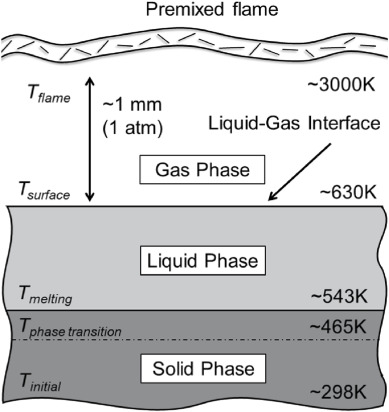 Chemical kinetic mechanisms are crucial for modeling combustion processes of solid propellants, but specific impacts of these mechanism parameters have not been fully assessed. As such, this study conducted a comprehensive sensitivity analysis on kinetics, thermodynamics, and transport parameters affecting combustion characteristics of solid propellants, exemplified with HMX as a case study. A one-dimensional steady-state numerical model incorporating gas and liquid phase detailed mechanisms was developed and validated, which enables a thorough sensitivity analysis of kinetics, thermodynamics, and transport data. This analysis revealed that gas kinetics predominantly govern HMX combustion compared to liquid ones, particularly at high pressures. Notably, the decomposition reactions of gaseous H2CNNO2 and N2O were identified as highly sensitive reactions that control the burning rate and the pressure exponent. By normalizing sensitivity coefficients of all parameters, heat capacities values of small gaseous molecules were found to be the most significant factors. In addition, the sensitivities of mechanism parameters on greenhouse gas emissions of the propellant were analyzed. This research could enhance our understanding of HMX combustion, underscore critical areas for future development and refinement of detailed kinetic mechanisms of solid propellants, and contribute to the design of greener and more efficient propellants.
- Access the article at the publisher: DOI: 10.1016/j.energy.2025.139402
Associated Themes:
