


Technical Report 346, c4e-Preprint Series, Cambridge
Reduced kinetic mechanism for turbulent combustion of ammonia/air mixtures
Reference: Technical Report 346, c4e-Preprint Series, Cambridge, 2026
Associated Themes:

- Compact reduced mechanisms developed for atmospheric-pressure ammonia/ air CFD
- PaSR tests captured finite-mixing quenching and sustained combustion
- Hot-rich mixtures remained reactive over wider mixing-time ranges
- Nitrogen fluxes showed similar dominant pathways across mixing rates
- PSR-based reduction matched PaSR-derived performance for tested cases
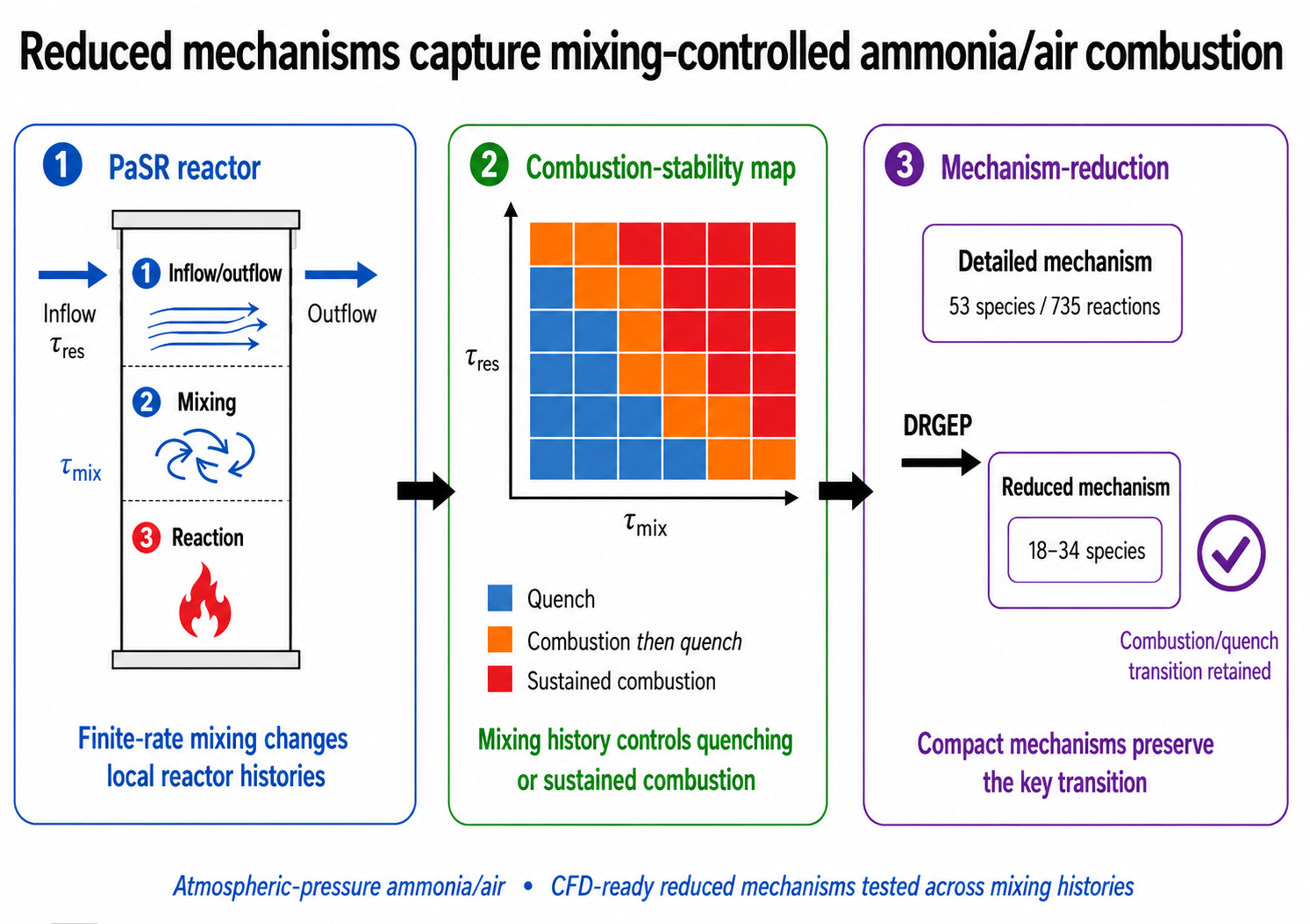 This paper presents compact reduced kinetic mechanisms for ammonia/air combustion at atmospheric pressure for use in computational fluid dynamics (CFD) simulations. Perfectly-stirred reactor (PSR) and partially-stirred reactor (PaSR) simulations were used to sample hot-lean and hot-rich initial conditions, residence time, and turbulent-mixing time. At short residence times, combustion stability depended strongly on turbulent mixing and initial conditions, with faster mixing shifting selected cases from quenching to sustained combustion. Flux analysis showed that the dominant nitrogen-species-pair network was broadly conserved between fast- and slow-mixing cases, while the different outcomes were explained by different equivalence-ratio–temperature histories. Reduced mechanisms were generated using the directed relation graph with error propagation (DRGEP) method from both PaSR-derived and PSR-derived datasets. Both reduction routes gave similar performance for the cases studied. The reduced mechanisms reproduced the detailed-model behaviour across the tested mixing histories while substantially reducing CPU time, yielding CFD-ready mechanisms for atmospheric-pressure ammonia/air combustion.
The reduced mechanisms supporting the article are available via the University of Cambridge data repository (doi:10.17863/CAM.131370). The DOI will be made live upon publication of the peer-reviewed version of this preprint.
PDF (3.7 MB)